
Chesterfield City Directory Collections
Chesterfield was incorporated in 1988, so older households usually appear under St. Louis County, an earlier community, or a post-office name rather than under a Chesterfield heading. The strongest starting point is the St. Louis County Library history and genealogy collection. Its holdings combine county directories with St. Louis city runs, telephone books, newspapers, maps, deed microfilm, court material, and family-history finding aids. A volume is a dated snapshot, not a complete roll of everyone in a place, but it can tie a surname to an address, a spouse notation, a trade, or a listed telephone subscriber.
| Collection | Years located | Where held | Access |
|---|---|---|---|
| St. Louis early directories | 1821 and selected years from 1836 to 1860 | SLCL microfiche, microfilm, and reference print | City-directory collection |
| St. Louis business directories | 1860; 1902-07; 1911-16; 1918-1928 | SLCL microfilm | Library research |
| Polk and reference directories | 1947-48; 1967-68; 1973-77; 1980 | SLCL print and microfilm | Reference collection |
| St. Louis County Directories | Collection arranged by year, including a 1938 example | SLCL Digital Archives | Free online, no card |
| White and Yellow Pages | 1968 city and county volumes | SLCL print | Ask at the desk |
County deed books for 1877-1931 and an ownership index for 1974-1992 can support the address side of a directory lead, but they identify ownership and transfer rather than an occupant by themselves. Telephone volumes help with listed subscribers, yet unlisted numbers do not appear. The library’s newspaper holdings add notices, obituaries, church names, civic events, and development context when a directory line ends too soon.
Chesterfield County Directory Scans
The SLCL St. Louis County Directories tutorial describes a free Digital Archives route that does not require a library card. Choose a year, search a name or part of an address, and then browse the alphabetic surname section. That last step matters. OCR can miss a faded name or misread a street, while the page image places the entry in its printed context. Copy the year, page, punctuation, initials, and street form before making any conclusion from a Chesterfield directory result.
For a scan that is difficult to read, the library provides a lookup-request service for indexed local-history and genealogy materials. Daniel Boone, Samuel C. Sachs, and Thornhill are the branches serving Chesterfield, while History & Genealogy is the systemwide specialty service. A request should name the source, surname variant, year or range, and the address fragment already known. It is better to request one tight lookup than to ask staff to identify a whole household from an uncertain story.
The Digital Archives instructions show the directory search route used for Chesterfield historical-directory research.
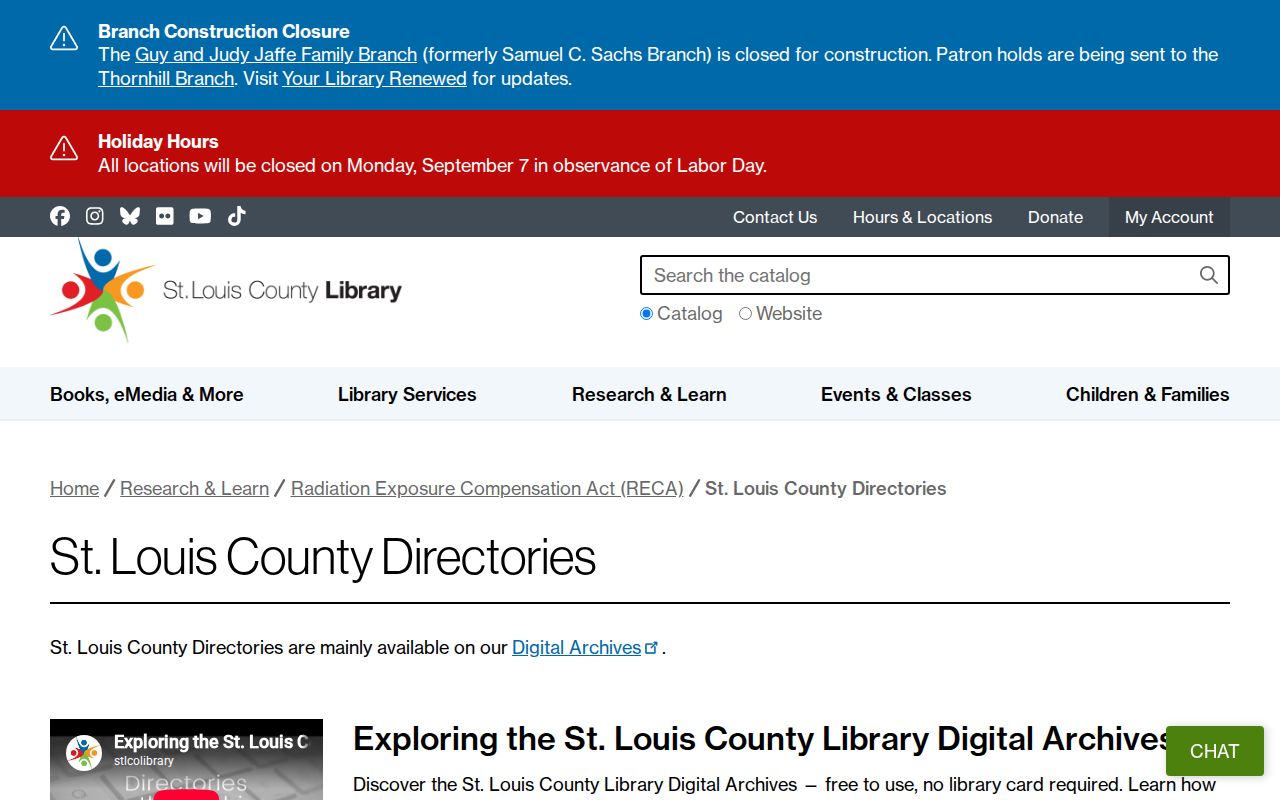
The scan illustrates why surname browsing should follow a text search, especially when an old address or initial was captured imperfectly.
Note: Search the surname and the address separately because a scan can recognize one while missing the other.
Chesterfield Directory History
Directory labels must be read against jurisdiction. St. Louis County was organized in 1812, and the independent City of St. Louis separated from the county in 1876. Chesterfield land belongs in county records after that split, even though older material may use a combined St. Louis City/County label. Before incorporation, the same land may be filed under Chesterfield, Gumbo, Howell or Howell's Landing, Bonhomme, Clarkson, or another old community and post-office label. A missing modern-city heading is not proof that a family was absent.
| 1812 | St. Louis County was organized. |
|---|---|
| 1876 | St. Louis City separated from St. Louis County, changing the jurisdiction name on later county records. |
| 1824-1861 | The searchable WPA surname index covers St. Louis County Court Books 1-10. |
| 1877 | County deed records begin in the post-split holdings used by SLCL and FamilySearch. |
| 1988 | Chesterfield incorporated, after generations of records created under county and community names. |
Rapid growth after incorporation adds another reason to test several labels. The city budget's historical series rises from 28,436 residents in 1988 to 47,484 in 2010, while the 2020 Census count was 49,999. Those numbers give scale to the change, not a list of people. For a local history search, old place names and a county label are often more useful than forcing a modern Chesterfield directory term onto an earlier record.
Reading Chesterfield Directory Entries
A directory entry can contain more than a name, but each part needs careful reading. The 1938 St. Louis County directory model includes a surname and given name, a spouse or household relationship when printed, a street address, occupation or employer, and sometimes a separate business address. Telephone editions can add subscriber information. Widow or deceased-spouse notation can be a useful time marker. Transcribe the direction, suffix, unit, initials, and any notation exactly, then locate the abbreviation key in that volume if one is printed.
| Name line | Surname, given name, and initials in alphabetic order. |
|---|---|
| Household clue | Spouse or relationship notation where the edition prints it. |
| Address | Street address, direction, suffix, and unit or apartment detail. |
| Work or business line | Occupation, employer, or separate professional address when shown. |
| Telephone clue | Subscriber information in telephone editions, not a record of every household. |
- Criss-cross directory
- A reverse section arranged by street and address rather than by surname, when an edition includes one.
- Householder index
- An index centered on the household name, useful for following the same address across issues.
- Abbreviation key
- The volume's explanation of shorthand marks; do not assume a mark has the same meaning in every directory.
A Chesterfield directory entry does not establish title, current residence, citizenship, or registration status. It might record a business, boarding address, office, or telephone subscriber. Use an assessor record, deed record, or census return when the question requires a second source.
Tracing Chesterfield Directory Families
Build a household trail one issue at a time. Begin with the county directory closest to the known date, then preserve every detail before searching nearby issues. A change in address, spouse notation, occupation, or listing form can point to a move, marriage, widowhood, or a different person with the same name. Pairing directory years with census records makes the result stronger: federal schedules from 1850 name household members and occupations, and the 1880 census adds relationship to the household head and parents' birthplaces.
- Choose the Chesterfield-area directory year nearest the known name, road, or subdivision.
- Record the entry and page exactly, including initials, spouse notation, address, occupation, and telephone detail.
- Check one to three years on either side, searching both surname and address because OCR may split the evidence.
- Compare the nearest federal census and Missouri state census or tax-list material where the time period permits.
- Use the county assessor locator and deed material only as a separate property check, then return to the directory under each relevant surname.
Missouri Archives provides federal census microfilm for 1830-1930 and state census or tax-list material for 1840-1876. The 1890 population schedules were destroyed by fire, so no directory gap can be filled by pretending that schedule survives. A person leaving a directory may have moved, died, changed a listing, or simply become unlisted. Newspapers, cemetery registers, probate material, and adjacent directory years can sort those possibilities.
Note: Keep the printed year and page with every transcription so a later researcher can check the original scan.
Chesterfield Court Book Names
The WPA typescript project is a distinct early-name source, not a directory. Its searchable index covers St. Louis County Court Books 1-10 from 1824-1861, and the wider microfilm record covers Books 1-23 from 1824-1877. Names may appear in an order, in a misspelled form, or without a familiar surname pattern. Search initials, alternate spellings, Saint and St. Louis forms, and the former community name before deciding there is no result.
The SLCL county court-records guide identifies the WPA index and the related microfilm. It can supply a name and date that lead back to a family group or land reference, particularly for Chesterfield-area research before the current municipal record system. Court-book evidence belongs beside, not inside, a directory timeline because the record was made for a different purpose.
Chesterfield Directory Address Checks
When a directory line provides an address, a three-way check can keep the history honest. Compare the entry with a county deed or plat for the legal description, then with the county assessor or parcel map for the current locator and situs. The annual directory contributes a name-and-address snapshot; the deed provides transfer information; the parcel record supplies the county's current property context. None of the three should be treated as a full household roster.
The FamilySearch catalog for St. Louis County deed records, 1877-1886 identifies direct and indirect indexes and original books filmed on 13 reels. A free account is required, and image access can depend on custodian restrictions. The Recorder of Deeds search route handles more recent document research through county-linked vendor services, while older books remain a library and archival task.
For a present-day street or parcel workflow, use the Chesterfield street directory rather than trying to make historic directory scans answer a current address question.
Chesterfield Directory Archive Routes
SLCL History & Genealogy is the main local route when scans are incomplete. Its collection includes city, county, farm, and telephone directories; maps; burial volumes; church records; yearbooks; local-history indexes; county court and deed microfilm; and FamilySearch microfilm that is not always available through the public website. Search the Local History Index by a church, subdivision, road, or institution as well as a surname. That often produces a relationship or nickname that separates two similar entries.
SLCL's History & Genealogy collection describes the institutional holdings behind this work. Chesterfield cemetery material is another local bridge: the city cemetery legend points to church, lodge, family, and historic burial sites, while each custodian is the place to ask about a burial register. Regional newspaper microfilm, including the 1991 Chesterfield Journal and Citizen Journal, can add dated notices that a directory lacks.
The St. Louis County Historical Society archival holdings note describes material held through Kathryn A. Martin Library Archives and Special Collections.
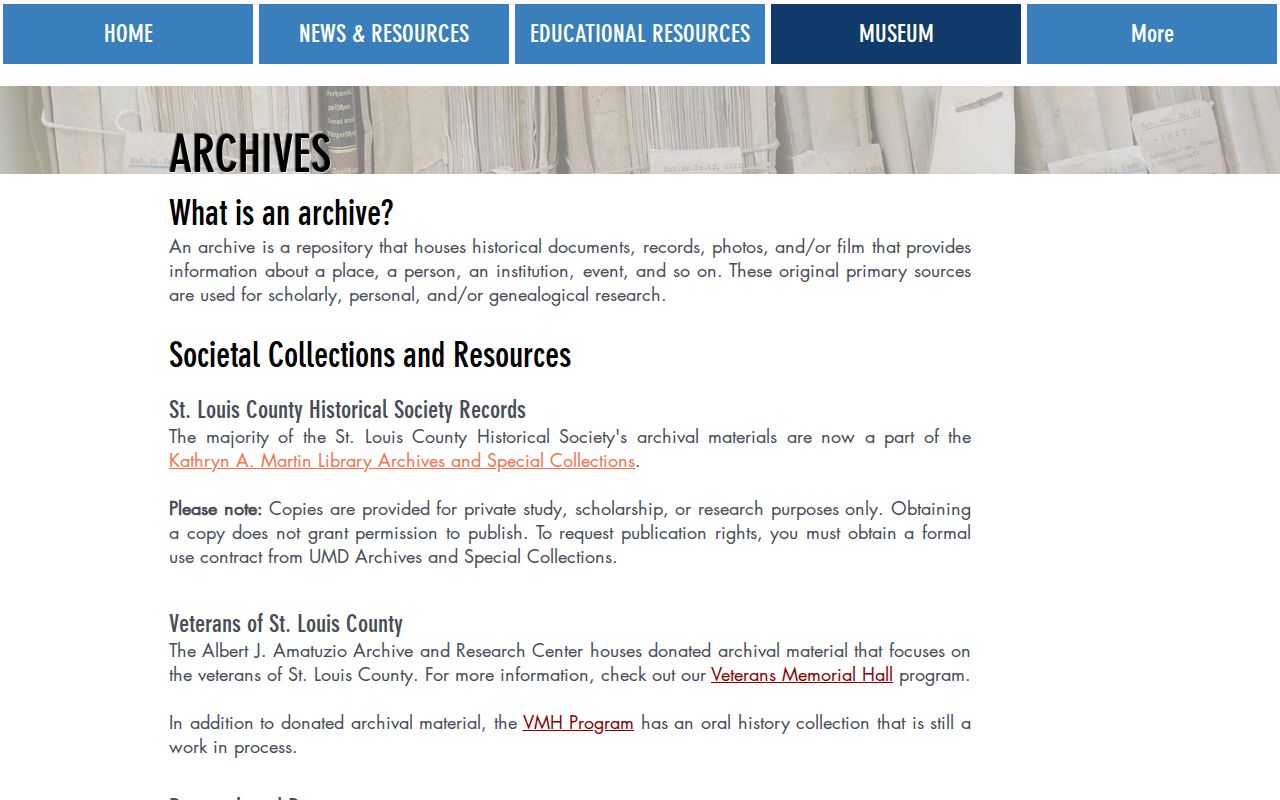
That archive route is appropriate for private study and scholarship when a Chesterfield directory scan or library index does not resolve a name.
Chesterfield Directory Runs
The SLCL city-directory index is the practical shelf list for selected St. Louis city and county volumes. Its early alphabetic and municipal runs start in 1821, while later business, Polk, reference, telephone, and county materials fill selected periods through 1980 and beyond by collection. Edition coverage differs, especially for suburban addresses, so a directory should be treated as a collection of year-specific publications rather than one uninterrupted database.
The SLCL city-directory collection page identifies the library source for these selected runs.
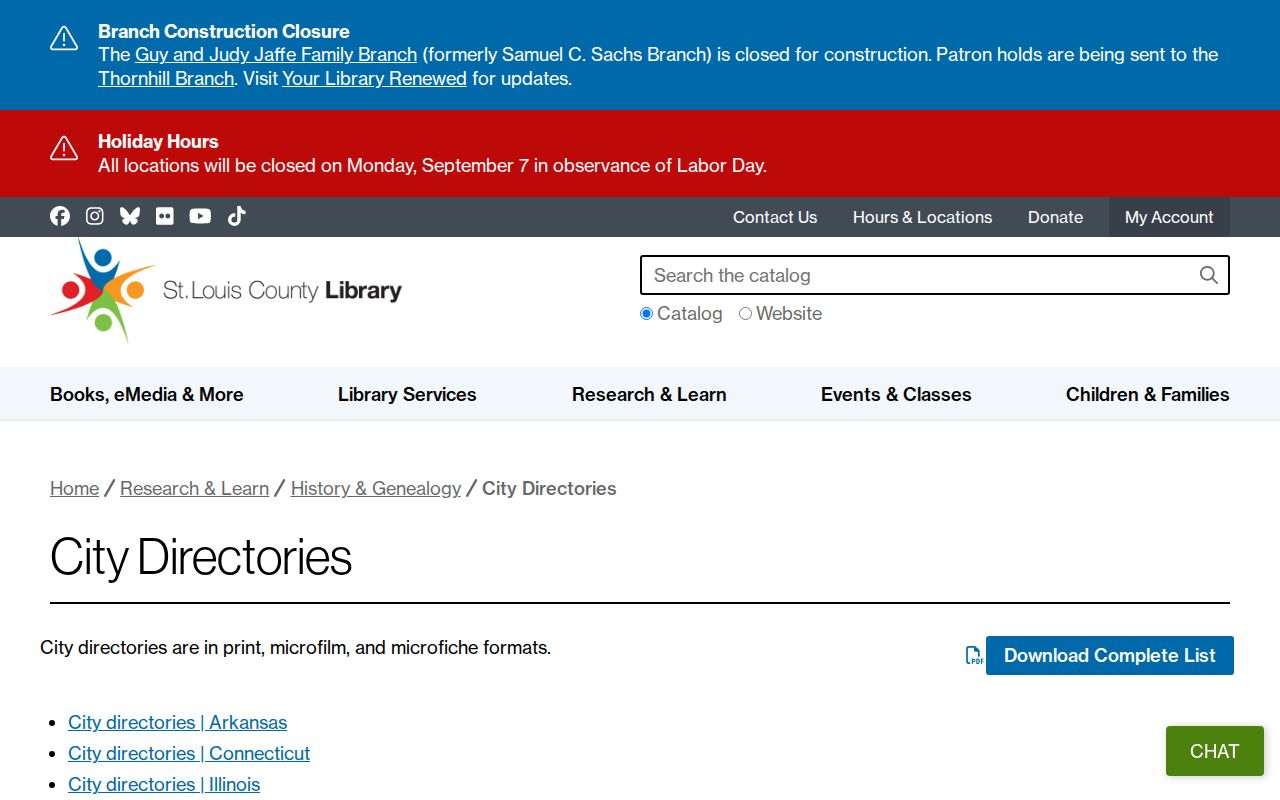
The library collection is the right starting point for comparing an early St. Louis volume, a later county directory, and a telephone book without treating them as the same record series.
Note: A directory's listed address can be a business or subscriber address, so confirm the question before drawing a family-history conclusion.